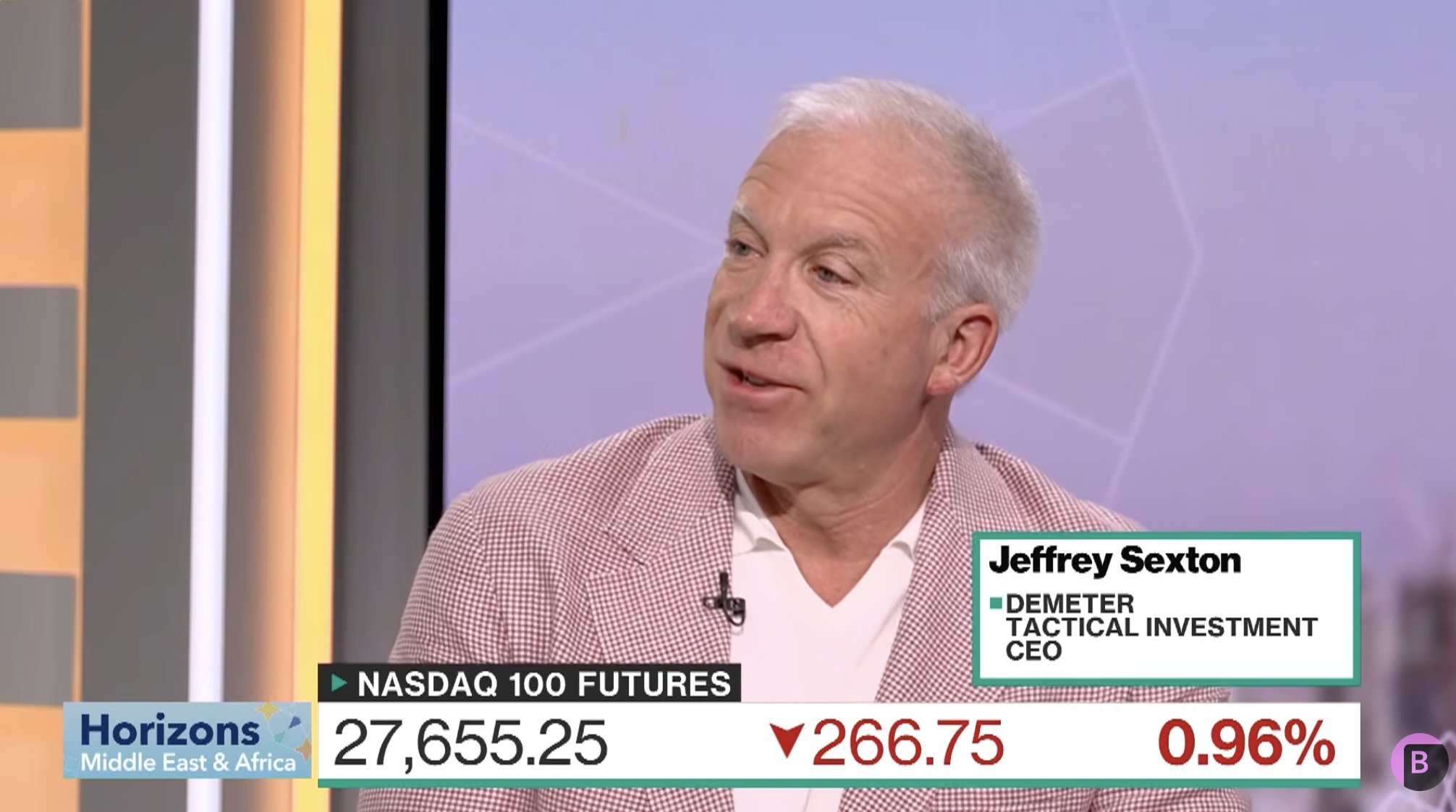
On 29 July 2026, Jeffrey Sexton appeared on Bloomberg TV’s Horizons Middle East alongside anchor Abeer Abu Omar to discuss the correction in technology and semiconductor stocks, changing expectations around artificial intelligence spending, and the outlook for Federal Reserve policy.
Speaking ahead of the Federal Reserve’s interest rate decision and a significant week for Big Tech earnings, Sexton argued that weakness in high-growth technology stocks should not automatically be mistaken for weakness across the entire economy.
Watch the Bloomberg TV Interview
Watch Jeffrey Sexton’s full interview on Bloomberg TV’s Horizons Middle East, covering technology and semiconductor valuations, Big Tech capital spending, Federal Reserve policy, market rotation and geopolitical uncertainty.
Source: Bloomberg TV, Horizons Middle East, 29 July 2026. Video used under licence.
Has the Technology “Ferrari” Crashed?
Sexton returned to an analogy used in his previous market commentary, comparing high-beta technology and artificial intelligence stocks to a red Ferrari travelling downhill without brakes.
In the latest interview, he argued that the correction he had warned about was now taking place.
He pointed to weakness in the Philadelphia Semiconductor Index and significant declines across technology-heavy Asian markets as evidence that parts of the sector had moved into correction territory.
However, his assessment was not that the entire global market was facing the same conditions. Instead, the pressure appeared concentrated in areas where valuations, expectations and investment spending had risen most aggressively.
Investors Are Watching Spending, Not Only Growth
A central theme of the interview was the growing scrutiny of Big Tech capital expenditure.
According to Sexton, markets are no longer assessing major technology companies only by asking how much revenue they generate. Investors are also examining how much those companies are spending to build artificial intelligence infrastructure and whether that spending is producing sufficient economic value.
Large investments in data centers, computing infrastructure and AI capacity may face greater scrutiny when the financial benefits are unclear or delayed.
This represents a shift toward greater capital discipline. Revenue growth remains important, but companies may increasingly be judged by how efficiently they convert spending into measurable results.
A Market of “Rolling Bubbles”
Sexton rejected the idea that global markets should be viewed as one single bubble moving toward a universal collapse.
Instead, he described markets as a series of “rolling bubbles,” where enthusiasm, capital and valuations move between different sectors and investment themes.
Under this view, tactical investing requires recognizing where momentum is building and understanding when conditions begin to change.
While parts of the technology and artificial intelligence sectors face pressure, Sexton highlighted greater resilience elsewhere in the market. Equal-weighted indices and sectors such as banking, manufacturing and mining continue to reflect established economic activity and cash generation.
The wider economy, particularly in the United States, may therefore be stronger than technology-focused headlines alone suggest.
Federal Reserve Policy and Political Uncertainty
Sexton also discussed the Federal Reserve’s near-term policy outlook.
At the time of the interview, he expected interest rates to remain unchanged. His reasoning included geopolitical tensions, uncertainty around energy prices, lower summer trading volumes and the likelihood of a cautious approach at the meeting.
Looking further ahead, he said the debate over potential rate increases or reductions could become more intense during the autumn.
Oil prices, geopolitical developments and economic data would remain important factors. Sexton also noted that the approach of the United States midterm elections could add further political pressure to the discussion around monetary policy.
Markets and Geopolitical Risk
The interview also examined the challenge of pricing geopolitical uncertainty.
Sexton argued that markets generally respond to the information available in real time. The greater difficulty arises when political positions, negotiations or international events change unexpectedly.
This can create a rapidly shifting environment in which market expectations must repeatedly adjust to new information.
For investors, the challenge is not simply identifying geopolitical risk. It is understanding which risks have already been reflected in market prices and which new developments may materially alter the outlook.
Important Information
This content is provided for general informational purposes only and summarises views expressed during an external media interview on 29 July 2026.
The views attributed to Jeffrey A. Sexton reflect opinions expressed at the time of the interview. Market, economic, political and geopolitical conditions may have changed since the interview was recorded, and the views described may be subject to change without notice.
Nothing on this page constitutes investment research, investment advice, financial advice, legal advice or tax advice. It does not constitute an offer, solicitation, recommendation or invitation to acquire or dispose of any investment or to enter into any investment transaction.
Please refer to Demeter Tactical Investments’ official legal and regulatory disclosures for further information.