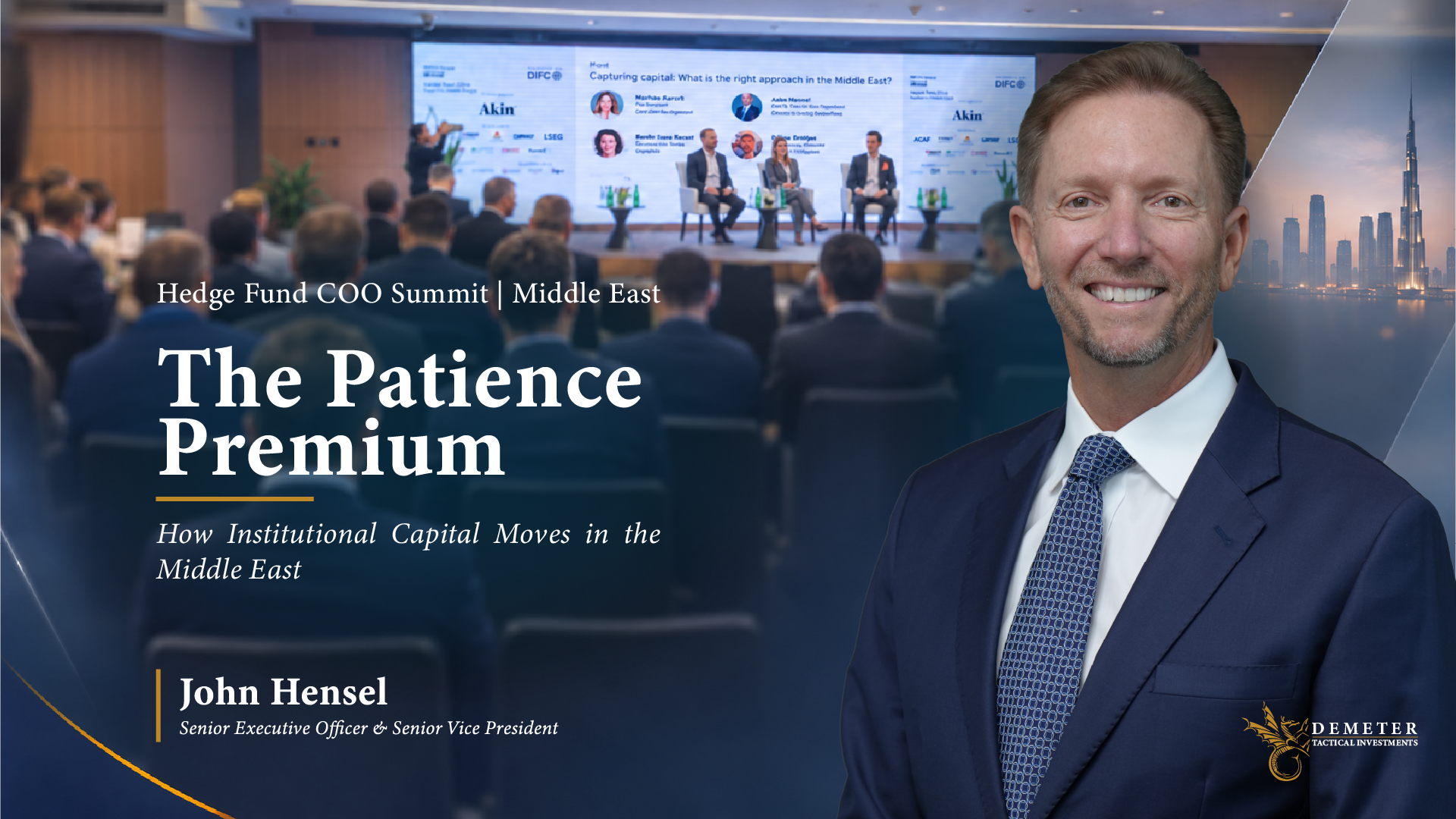
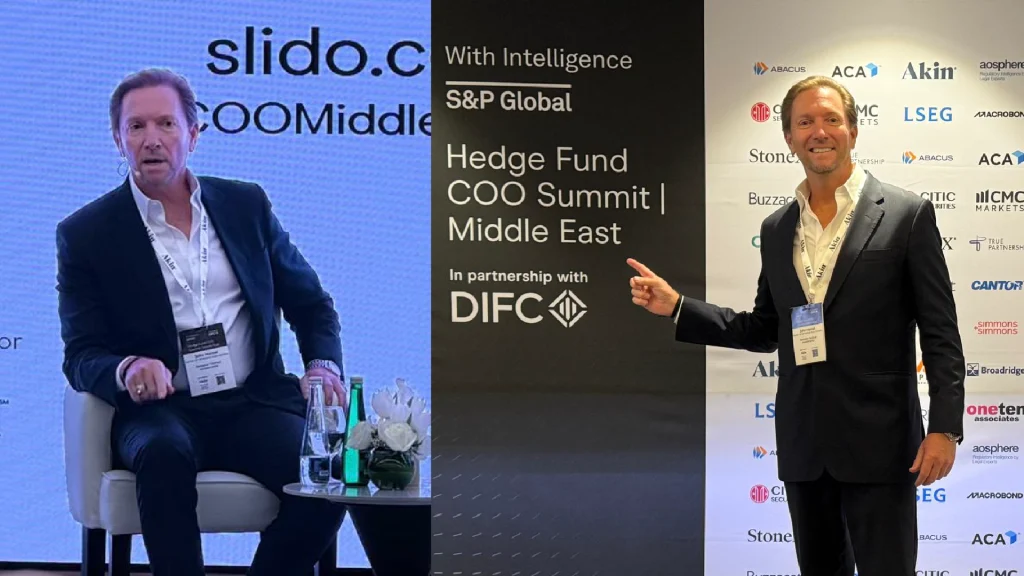
John Hensel, Senior Vice President Middle East at Demeter Tactical Investments Middle East, spoke at the recent Hedge Fund COO Summit | Middle East at the Dubai International Financial Centre (DIFC), on a panel titled “Capturing capital: What is the right approach in the Middle East?” Drawing on Demeter’s own experience of raising capital in the UAE, he talked about how long allocators in the country take to commit, how fund structures can reflect where an investor is comfortable doing business, and what the UAE’s regulators expect of managers who set up here. His central message for managers new to the UAE was that capital here follows long-term relationships and takes time to arrive. Colin Bridges of Cantor Fitzgerald moderated the discussion, and John was joined on the panel by Michela Ferrulli of Calibrate Management and Sarah-Jane Elsner, a specialist financial regulation lawyer at aosphere.
The Real Timeline of Capital
The panel opened with the question most managers bring when they first look at the region: how long does it take to get from a first meeting to a funded commitment? Many arrive with internal timelines built for faster markets, and the distance between those plans and the pace of local allocators usually becomes clear only once conversations are under way. Quick allocations do happen, though they are the exception in a market where relationships are built over years and capital follows those relationships.
Hensel told the audience that managers should adjust their expectations even after a very positive first exchange, because allocators here judge a manager on consistency over time. “I’ve had allocators who’ve watched for more than a year, and still are watching,” he said. He then described the commitment in terms of how long it lasts: “This is a marriage. We are looking for allocators who are looking to make investments at five to 10 or more years. I wouldn’t expect anybody to make a decision like that very lightly.”
Structuring for the Allocator
The conversation then moved from timing to deployment. Bridges asked the panel about fund domicile, and in particular the choice a manager faces once an investment committee is ready to proceed: set up vehicles locally, or rely on the traditional offshore centers.
Hensel’s view was that a fund’s structure should reflect where the allocator is comfortable doing business. “If I position my product with a family office that has its roots in India, or in Kenya, or in the UAE, they’ve been doing business in this region for decades,” he explained. “This is a very comfortable place for them to do business.” European investors, by contrast, often prefer the regulatory environments they already know. For that reason Demeter has chosen to offer allocators a choice of structure. “We’ve taken the approach of having optionality for the allocator, depending on where they’re from,” he added.
The UAE’s fund passporting regime, agreed between the Securities and Commodities Authority, the Dubai Financial Services Authority and the ADGM’s Financial Services Regulatory Authority, allows a domestic fund registered in one of the country’s jurisdictions to be marketed to investors across the UAE, and Hensel said this creates optionality for allocators. “The passporting regime here is very strong,” he said. “The more you can meet them where they are, and meet them with products that they’re comfortable with, and that they find accessible, and that they trust, it’s going to create opportunities for you to close transactions.”

The Regulatory Cost of Entry
The session closed on what it takes to offer that choice in practice. A manager operating in more than one jurisdiction comes under each of the region’s regulatory frameworks, and centers such as the Abu Dhabi Global Market, where Demeter operates, set a high bar for compliance that managers have to meet from the outset and keep meeting. Hensel was direct about what newcomers should expect. “The standards are extremely high. The expectations from compliance and regulation are very high,” he said. “If you intend to come in here and do business, expect that, expect it to take longer than you might have hoped it would take.”
The panel’s picture of capital raising in the region was of a long-term undertaking, in which the managers best placed to build lasting relationships with allocators are those who establish a local presence, work within the regional compliance frameworks and give allocators the time they need.