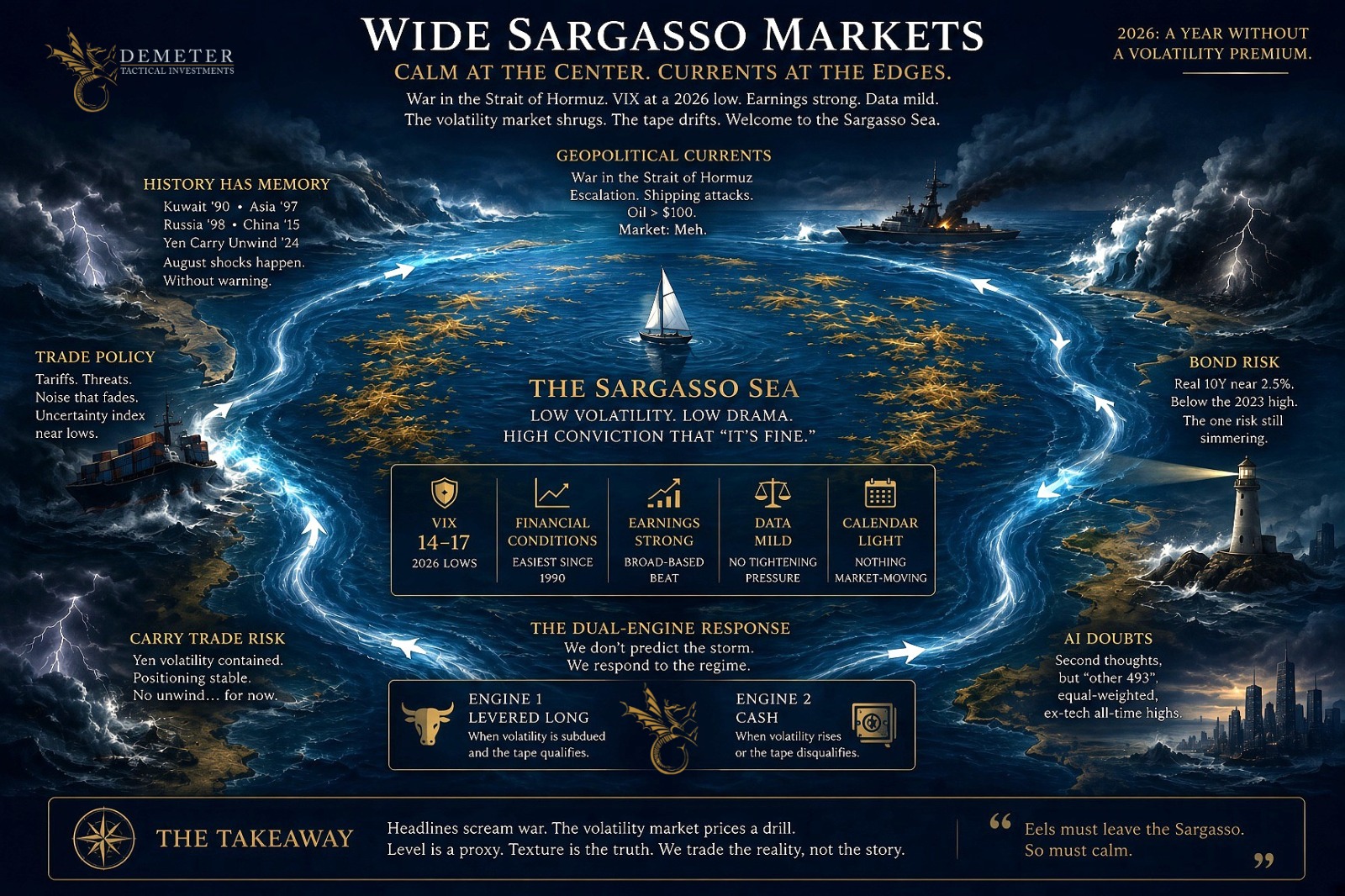
Markets are drifting through what John Authers calls their summer Sargasso Sea while a conflict simmers over the world’s most important oil chokepoint. Here is our Demeter view of the year without a volatility premium.
By Jeffrey A. Sexton, Founder and Chief Investment Officer, Demeter Tactical Investments (ME) Ltd.
In his Points of Return newsletter for Bloomberg Opinion this week, John Authers compared today’s markets to the Sargasso Sea, a stretch of unusually calm Atlantic water ringed by strong currents. His case is straightforward: the VIX has posted its lowest closes of the year, Bloomberg’s financial conditions index shows the easiest conditions since the series began in 1990, broad equity measures beyond the big technology names have made new highs, and with earnings strong, the economic data mild and little on the calendar, he sees a market with good reasons to stay quiet for now. He calls the mood “irrational equanimity,” noting that investors seem convinced (rightly or wrongly) that the year’s geopolitical risks are safely boxed away. It is that conviction I want to dwell on, because there is another way to read this market.
From our vantage point at Demeter, the strangest thing about this year is how a war failed to result in a volatility premium. An armed conflict has been grinding on in the Gulf since late February. The Strait of Hormuz, the choke point for a fifth of the global oil supply, has been closed, contested, and warily tiptoed back open; crude spiked past a hundred dollars; and the ceasefire that limped in during April fell apart by July. Nothing captures the absurdity of it quite like that day: renewed strikes hit shipping in Hormuz, and the volatility market simply shrugged its shoulders, yawned and went back to sleep. The VIX closed below seventeen, then pushed it lower two sessions later to a 14-handle. Faced with an actual war, the options market instead just priced a military drill.
The striking part is how the market reaction stacks up against recent history. The overall peak reaction to this conflict was milder than its response to the invasion of Ukraine, milder than the 2022 bear market trough, and milder than a trade tariff announcement from a year prior. Seen analytically, a conflict of this magnitude, with the world’s primary oil chokepoint shut down, has been priced with more calm than a U.S. presidential press conference upending 85 years of global trade. Whether the market is right to be so relaxed is a question Authers leaves open, and we will too. We are not going to predict how long this calm lasts or whether it is a calm before a storm. We are simply noting it as the reality that has defined our year.
For a systematic investor, this whole episode leaves behind a lasting lesson. The regime that actually matters is the one priced by the volatility market, not the one painted by the headlines. Headlines have screamed war all year, while the options market has priced a routine drill. Only one of those environments dictates how risk gets priced and paid. A war by itself does not profit a strategy like Demeter’s; the volatility a war (usually) triggers does. When those two decouple, as they have through 2026 so far, our stance is to trade the reality in front of us instead of the story plastered across front pages.
The level of the VIX is not even the whole story, because an index is just a proxy for the mechanism rather than the mechanism itself. What our daily trading process actually consumes is texture. By texture, we mean whether the tape oscillates or drifts, whether pullbacks qualify as entry points, and whether a given day gives Demeter’s systematic trading rule anything to latch onto. We have lived through placid years where the tape oscillated enough for a systematic process to trade right through them, and loud years where the entire second half turned into an uninterrupted drift with no trading days worth buying. That is why our shorthand has always been simple: level matters, but texture decides.
For a strategy built like ours, a becalmed sea is premium season rather than a crisis. Low volatility stretches are when a disciplined process quietly pays its insurance premiums. Participation stays conditional, and selectivity carries a cost that becomes most obvious right when nothing seems to go wrong. Elevated volatility regimes are the season when the insurance policy finally pays out. Neither season announces itself in advance. Neither is ours to schedule. The market environment decides when the weather changes, not us, and all of that was built into our design long before the summer of 2026 ever arrived.
Authers closes by noting that the eels always leave the Sargasso eventually, and August has a long memory for proving that right. Think back to Kuwait in 1990, the Asian Financial Crisis in 1997, the Russian default in 1998, China’s devaluation in 2015, or the yen carry unwind two summers ago. All of them happened in late summer (July-September). None of them rang a warning bell beforehand. There is no gas leak smell before a collapse that kills the canary in the coalmine just before distaster strikes, which is why we do not waste our days trying to sniff one out. Demeter’s dual engine process asks one question every trading day and answers it by strict rule at 3:59pm New York time, putting us either invested or in cash. During a Sargasso summer or the doldrums when no wind blows in the sails of a great ship, the answer of Demeter’s algorithm (don’t invest, stay in cash or only invest just a scant few days) can look entirely uneventful for weeks on end, and that is completely fine by us. The discipline was established long before this weather arrived, and it will rise to the occasion and be ready for duty when the currents pick up and the winds change.
Read John Authers’ full piece at Bloomberg Opinion: Markets Are Serene in Their Summer Sargasso Sea.
Jeffrey A. Sexton is Founder and Chief Investment Officer of Demeter Tactical Investments.
About Demeter Tactical Investments: Demeter Tactical Investments is a quantitative investment manager operating from the Abu Dhabi Global Market (ADGM). The firm runs proprietary, systematic strategies in liquid US and international equity markets, applying a price-based process informed by Nobel Prize-winning empirical research, with a track record of more than 13 years. www.demeter-funds.ae
This commentary reflects the personal views of the author, is published for informational purposes only and does not constitute investment advice, an offer or a solicitation. It contains no performance information and makes no forecasts. Demeter Tactical Investments (ME) Ltd. is regulated by the ADGM Financial Services Regulatory Authority (Category 3C). Demeter Tactical Investments Corp. is an SEC-registered investment adviser. Past performance is not indicative of future results.